
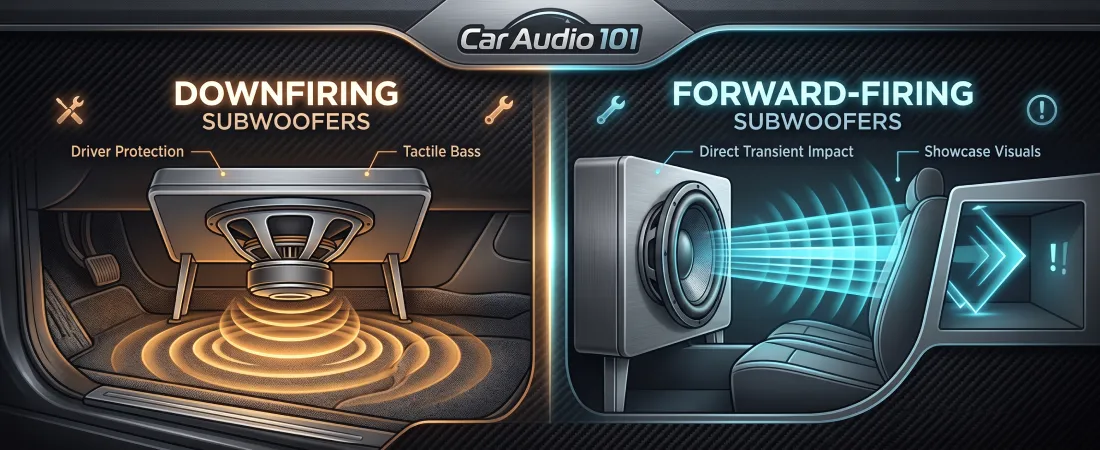
Choosing the orientation of your subwoofer enclosure is one of the most critical decisions when planning a car audio build. While box volume and port tuning establish the baseline acoustic output, the direction the subwoofer cone faces directly influences boundary loading, cabin gain, tactile feedback, and driver protection.
Enthusiasts frequently debate whether aiming a subwoofer downward toward the vehicle floorboard or forward into the listening cabin yields superior sound quality and volume. Understanding the acoustic mechanics behind driver orientation allows you to select the best setup for your vehicle layout and listening preferences.
Low-Frequency Acoustics and Omnidirectional Waves
Human hearing localizes high frequencies easily, but low frequencies below 80 Hz behave omnidirectionally. Sound waves in the deep bass spectrum have physical wavelengths measuring between 14 feet and 56 feet:
In this formula, $\lambda$ represents wavelength, λ is the speed of sound, and f is the reproduced frequency.
Because the interior dimensions of a passenger vehicle cabin are far smaller than these physical wavelengths, deep bass does not travel as a narrow acoustic beam. Instead, the entire passenger compartment acts as a pressurized acoustic chamber.
Even though bass radiates in all directions, the physical boundary surfaces directly adjacent to the subwoofer cone create acoustic loading. Aiming a driver at a hard floor or into open cabin space alters reflection paths, boundary reinforcement, and mechanical vibration transfer.
Downfiring Subwoofers: Mechanics and Characteristics
A downfiring enclosure positions the subwoofer driver on the bottom panel of the cabinet, firing directly toward the floor of the vehicle. Integrated standoff legs elevate the cabinet to maintain a specific clearance gap between the cone surround and the carpet.
Advantages of Downfiring
- Complete Physical Protection: The cone, surround, and dust cap are concealed beneath the enclosure, protecting fragile components from groceries, tools, cargo, and passenger feet.
- Tactile Bass Transfer: Coupling the driver’s pressure wave against the floorboard transfers mechanical energy directly into the vehicle chassis, increasing the physical sensation of bass.
- Acoustic Low-Pass Filtering: The confined space between the driver baffle and floor acts as a natural acoustic filter, dampening unwanted upper-harmonic distortion and mechanical noise from the cone.
- Stealth and Utility: Downfiring enclosures allow cargo to be stacked directly on top of the cabinet without risking puncture damage or cone interference.
Disadvantages of Downfiring
- Clearance Constraints: The enclosure must sit on standoff legs high enough to accommodate the driver’s maximum linear excursion ($X_{\text{max}}$); insufficient clearance causes the cone to slap the floor or carpet.
- Carpet Absorption: Thick plush carpet or sound insulation directly beneath the driver can absorb high-frequency bass harmonics, slightly muting upper-bass snap.
- Cone Sag Over Time: Extremely heavy, high-mass cones mounted horizontally in a downfiring orientation can develop suspension sag due to continuous gravitational pull over years of use.
Forward-Firing Subwoofers: Mechanics and Characteristics
A forward-firing setup orients the subwoofer driver vertically on the front baffle, aiming sound directly toward the front seats or open cabin area.
Advantages of Forward-Firing
- Direct Transient Impact: Firing directly into open air allows sound pressure waves to reach listeners without immediate surface reflection, delivering sharp transient snap and punchy kick drums.
- Zero Floor Clearance Restrictions: Because the driver operates on a vertical baffle, clearance height from the floorboard is irrelevant, allowing for long-throw subwoofers with extreme excursion.
- Showcase Visuals: Exposed custom cones, carbon fiber dust caps, and custom accent rings remain fully visible for show-quality installations.
Disadvantages of Forward-Firing
- Exposure to Damage: An exposed driver face is vulnerable to loose objects sliding around a trunk or cargo area unless protected by a heavy metal grille.
- Seat Back Damping: In sedans and hatchbacks, placing a forward-firing box directly against dense foam seats can muffle sound waves and create rattles in rear seat latches.
- Loss of Cargo Utility: You cannot place cargo against the front face of the box without blocking cone travel and choking bass output.
Comparison of Subwoofer Orientations
| Parameter | Downfiring Enclosure | Forward-Firing Enclosure |
|---|---|---|
|
Cone Protection |
Superior (Fully shielded underneath) |
Low (Requires protective grille) |
|
Cargo Utility |
High (Items can sit directly on box) |
Limited (Front baffle must remain clear) |
|
Bass Character |
Deep, warm, highly tactile chassis rumble |
Punchy, immediate, crisp transient attack |
|
Excursion Sensitivity |
High (Requires adequate leg clearance) |
Low (Unlimited forward air space) |
|
Ideal Vehicle Type |
Pickup trucks, SUVs, commercial work vans |
Sedans (through ski pass), competition builds |
Vehicle Cabin Dynamics: Choosing the Right Direction
Optimal orientation depends heavily on your vehicle body style and available mounting space:
Pickup Trucks
In crew cab and extended cab trucks, downfiring enclosures mounted under the rear bench seat are the industry standard. Firing down against the cab floor protects drivers from passenger feet, maximizes boundary loading, and delivers clean bass without sacrificing interior seating. In single cab trucks, forward-firing behind the passenger seat is generally preferred due to tight floorboard dimensions.
SUVs and Hatchbacks
Downfiring enclosures work well in cargo areas because owners can load luggage, sports equipment, or groceries directly on top of the cabinet without worry. However, if maximum sound pressure level (SPL) is the goal, rear-facing or upward-facing enclosures often yield higher meter numbers due to corner loading off the rear hatch glass.
Sedans with Closed Trunks
Downfiring boxes are rarely used in sedan trunks due to spare tire wells, uneven floor pans, and vertical height limitations. In sedans, forward-firing enclosures that seal tightly against the rear seat bulkhead through a fold-down armrest or ski pass-through produce clean sound by firing bass straight into the cabin while decoupling trunk lid rattles.
Review our guide on sealed vs. ported boxes to select the right enclosure design for your orientation.
Recommended Video Resources
Hoffman’s Iron Law: Subwoofer Box Size vs Low-End Extension
In this tutorial, Mark from Car Audio Fabrication explains how box size, sensitivity, and low-end frequency extension interact using Hoffman’s Iron Law.
How to Position Your Subwoofer for Loud Bass
An overview examining how facing a subwoofer forward, backward, or downward interacts with boundary surfaces to produce maximum output.
Common Mistakes
- Insufficient Floor Standoff Height: Installing downfiring boxes without adequate leg clearance causes the cone or surround to strike the floor during high excursion, damaging the driver.
- Placing Forward-Firing Boxes Flush Against Seats: Pushing a forward-facing driver directly against rear foam seats chokes airflow and muffles transient response.
- Flipping Standard Boxes Upside Down: Inverting a standard forward-firing cabinet onto the floor without engineered standoff feet suffocates the driver and burns voice coils.
- Leaving Forward Drivers Unguarded: Failing to install sturdy metal bar grilles over forward-facing subwoofers in trunks leaves cones vulnerable to shifting cargo.
- Ignoring Phase Inversion: Failing to test reverse phase (180°) at the amplifier after changing box direction can result in destructive acoustic cancellation with front door speakers.
References
- Sonic Electronix Learning Center – What is Polyfill & How Does It Affect Enclosure Volume?
- Crutchfield Learning Center – How to Choose and Position a Car Subwoofer
- JL Audio School of Sound – Understanding Audio Fundamentals and Enclosure Physics