
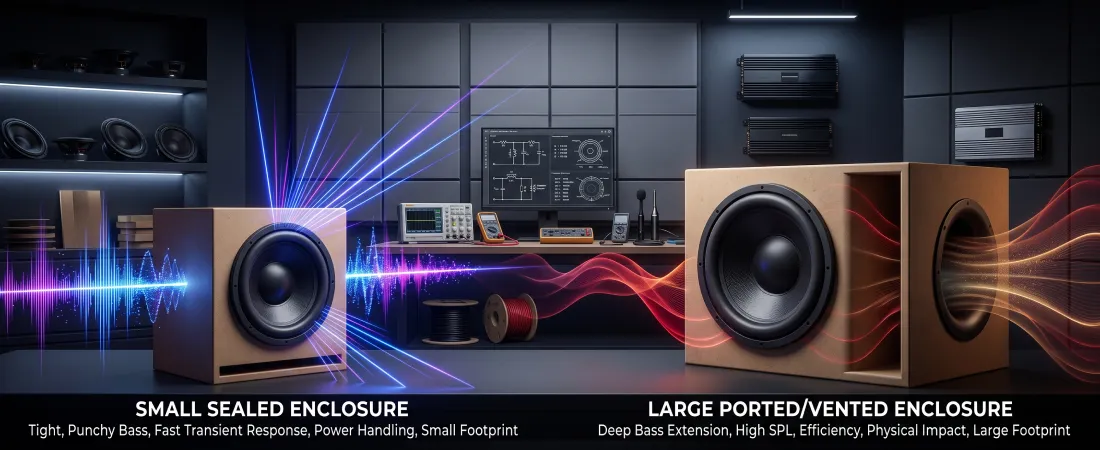
The internal volume of a subwoofer enclosure is one of the most critical factors determining how bass sounds in your vehicle. While many enthusiasts believe that maximum bass output is purely a function of amplifier wattage and driver diameter, the air volume inside the cabinet directly controls how the speaker cone physically moves.
An enclosure does far more than hold a driver in place; the trapped air functions as an acoustic spring that interacts dynamically with the subwoofer suspension. Understanding how enclosure volume alters frequency response, mechanical power handling, and transient accuracy allows you to tailor your bass system to match your vehicle’s cabin and your musical tastes.
Hoffman’s Iron Law: The Three-Way Compromise
In loudspeaker engineering, enclosure design is fundamentally constrained by acoustic physics. In the early 1960s, acoustic engineer J. Anton Hoffman (of Acoustic Research and KLH) formulated what is widely known in speaker design as Hoffman’s Iron Law.
The law dictates that loudspeaker performance is locked between three interdependent variables:
- Enclosure Size (Internal cabinet volume)
- Efficiency / Sensitivity (Acoustic output per watt of input)
- Low-Frequency Extension (How deeply and flatly the system plays into the sub-bass spectrum)
According to Hoffman’s Iron Law, you can optimize any two of these characteristics, but only at the direct expense of the third:
- If you want deep low-end bass in a compact enclosure, system efficiency plummets, requiring massive amounts of amplifier power to achieve high sound pressure levels.
- If you want high efficiency in a compact enclosure, the driver cannot reproduce deep sub-bass frequencies, rolling off sharply below upper-bass tones.
- If you want high efficiency and deep low-frequency extension, the enclosure must be physically large.
Designing a subwoofer system is always an engineering exercise in balancing these tradeoffs against available vehicle cargo space.
What Happens in an Undersized Box?
When an enclosure is built smaller than the manufacturer’s recommended air space, the trapped volume of air acts as an exceptionally stiff acoustic spring. This increased air stiffness exerts intense pneumatic pressure against the back of the subwoofer cone, altering the system’s acoustic behavior:
- Elevated Resonant Peak: The resonant frequency of the system (Fc in a sealed box) shifts upward, creating a prominent output hump in the 50 Hz to 70 Hz range. This delivers punchy, aggressive bass often described as “tight” or “boomy,” but compromises deep sub-bass reproduction.
- Reduced Low-Bass Extension: The stiff air spring restricts the cone’s excursion at low frequencies, causing acoustic output below 40 Hz to roll off rapidly.
- Increased Mechanical Power Handling: Because the dense air spring prevents the cone from over-stroking, the driver can withstand higher mechanical wattage before bottoming out.
- Lower System Efficiency: The amplifier must deliver significantly more current to overcome internal pneumatic resistance, generating higher voice coil heat for a given volume level.
What Happens in an Oversized Box?
Conversely, building an enclosure larger than the manufacturer’s recommended volume creates a compliant, loose air spring. The larger air mass offers little physical resistance to cone displacement, leading to distinct sonic characteristics:
- Deeper Sub-Bass Extension: The lower system resonance allows the subwoofer to play deeper into the sub-audible range (20 Hz to 30 Hz), yielding a natural, linear frequency curve that blends effortlessly with cabin gain.
- Higher Efficiency at Low Frequencies: The cone moves freely with minimal pneumatic drag, producing more acoustic output per watt of amplifier power across lower octaves.
- Decreased Mechanical Power Handling: With little air resistance cushioning cone motion, the driver reaches its maximum linear excursion (Xmax) under far less amplifier power.
- Risk of Physical Bottoming Out: Oversized enclosures require careful amplifier gain setting and active infrasonic filtering to prevent torn spiders, distorted suspensions, and voice coil former collisions against the back plate.
Sealed Box Alignment and the Qtc Factor
In sealed enclosures, the relationship between box volume and sonic performance is mathematically defined by the total system damping factor, or Qtc. The system Qtc is derived from the driver’s Thiele/Small free-air total Q(Qts) and equivalent compliance volume (Vas) relative to the net internal box volume (Vb):
Qtc = Qts
√(Vas / Vb + 1)
| Qtc Value | Alignment Classification | Sonic Character & Transient Response |
|---|---|---|
|
0.577 |
Bessel Alignment |
Exceptional transient response and zero ringing. Bass rolloff starts early but decays very smoothly, delivering audiophile-grade fidelity. |
|
0.707 |
Butterworth (Critically Damped) |
The engineering benchmark for ideal sealed enclosures. Delivers the flattest frequency response, optimal low-frequency extension, and tight, controlled transients. |
|
0.800 – 0.900 |
Moderate Peak Alignment |
A slight 1 dB to 1.5 dB output peak in the upper-bass register with a steeper low-end rolloff. Common in compact factory-style enclosures. |
|
1.000+ |
Chebychev (Underdamped) |
Highly compressed internal air space resulting in a prominent boomy peak between 50 Hz and 65 Hz. Output drops sharply below 45 Hz, producing one-note bass. |
To compare sealed performance dynamics against vented alignments, review our detailed guide on sealed vs ported boxes.
Gross Volume vs. Net Volume (Vb)
When calculating enclosure size, a common mistake is failing to distinguish between gross internal volume and net internal volume (Vb).
Gross volume is the total empty air space inside the outer wooden shell (Length × Width × Depth divided by 1,728 to convert cubic inches into cubic feet). However, the driver relies on net internal volume (Vb), which represents the actual air space remaining once all interior hardware is installed.
To calculate true net volume (Vb), you must subtract three critical displacements from gross volume:
- Subwoofer Driver Displacement: The physical volume occupied by the driver basket, magnet assembly, and rear cone structure inside the box (typically 0.05 to 0.15 cu ft per driver).
- Internal Bracing Displacement: The volume consumed by structural wood dowels, matrix window braces, and corner cleats. Learn more in our guide on subwoofer box bracing and air leaks.
- Port Duct Displacement (Ported Boxes Only): The physical air volume displaced by the internal port walls and the air channel itself.
If you build a box matching manufacturer specs without accounting for these internal physical displacements, the enclosure will perform as an undersized box, altering intended tuning and acoustic behavior.
Recommended Video Resources
Hoffman’s Iron Law: Subwoofer Box Size vs Low-End Extension
In this tutorial, Mark from Car Audio Fabrication explains how box size, sensitivity, and low-end frequency extension interact using Hoffman’s Iron Law.
Port Tuning Formula & How Box Volume Affects Tuning
This video demonstrates how enclosure internal volume (Vb) alters resonance frequency and how changing box dimensions shifts tuning curves.
Common Mistakes
- Confusing Gross Volume with Net Volume: Building an enclosure to the recommended cubic footage without factoring in driver displacement and internal bracing results in an unintentionally undersized box.
- Choking the Subwoofer in a Micro-Enclosure: Severely undersizing a cabinet to save trunk space creates an aggressive Qtc spike (>1.1), making bass boomy and causing drivers to overheat under increased power demands.
- Overpowering Drivers in Large Enclosures: Supplying full amplifier RMS wattage to a driver in an oversized enclosure without accounting for lowered mechanical excursion limits often causes voice coil bottoming.
- Relying Solely on Polyfill for Volume Correction: Adding polyfill to a box yields an apparent acoustic volume increase of approximately 10% to 15%, but it cannot turn a severely undersized cabinet into an optimal acoustic enclosure.
- Ignoring Cabin Gain Transfer Functions: Evaluating box response solely on free-air modeling software ignores the vehicle cabin, which naturally boosts low frequencies below 60 Hz to 80 Hz.
References
- Sonic Electronix Learning Center – What is Polyfill & How Does It Affect Enclosure Volume?
- Crutchfield Learning Center – Sealed or Ported Subwoofer Enclosures: Which Is Right for You?
- JL Audio School of Sound – Understanding Audio Fundamentals and Enclosure Physics