
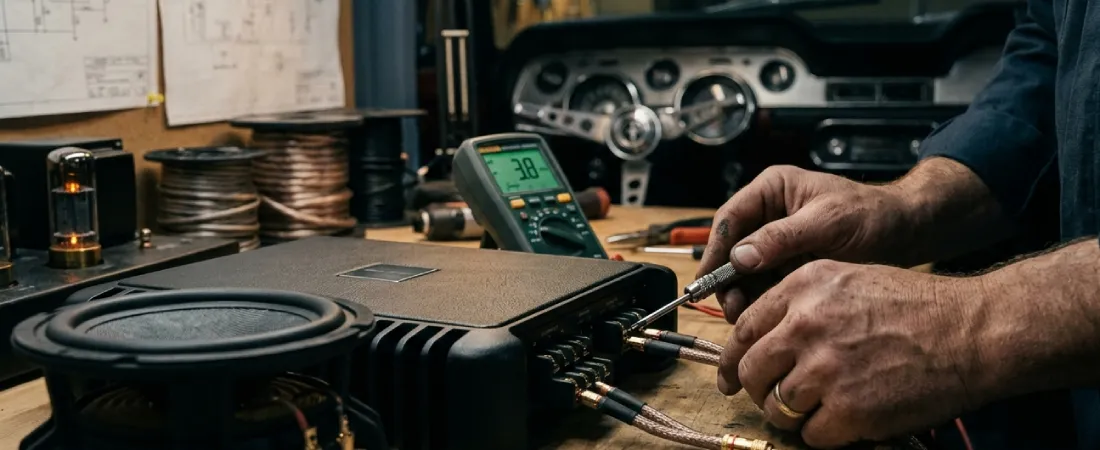
One of the most common questions in car audio is, “Which amplifier do I need for these speakers?” Many beginners believe that matching brands is enough, but true compatibility is determined by physics and electrical engineering. Matching amplifiers to speakers (or subwoofers) is about balancing two critical factors: Impedance (Ohms) and Continuous Power (RMS). When these two factors are aligned, your system will play efficiently, sound clean, and remain reliable for years.
Phase 1: Impedance Matching (The “Load”)
Before looking at wattage, you must understand impedance. Impedance, measured in Ohms (Ω), is the electrical resistance a speaker presents to an amplifier. Think of it like a pipe: a lower Ohm rating (like 2 ohms) is a “wider pipe” that allows more electricity to flow, while a higher rating (like 4 ohms) is a “narrower pipe.”
- The Amp’s Limit: Every amplifier has a minimum impedance it can safely handle (e.g., “2-ohm stable”). If you connect a speaker load lower than the amp is rated for, the amp will attempt to push too much current, leading to thermal failure. Learn more in our guide to Ohms & Impedance.
- The Power Relationship: Amplifiers typically produce more power as impedance drops. Your goal is to ensure the speaker’s impedance matches the amplifier’s design limits to maximize efficiency without overstressing the power supply.
Phase 2: Power Matching (RMS vs. Peak)
Once you have the correct Ohm load, you must match the wattage. You should always ignore “Peak” or “Max” power ratings on the box; these are marketing numbers that do not reflect real-world performance. Focus exclusively on RMS (Root Mean Square), which represents the continuous power a component can handle or produce safely.
- The 75% to 150% Rule: For optimal performance, your amplifier should deliver between 75% and 150% of the speaker’s total RMS rating.
- Why Headroom Matters: Providing slightly more power than the speaker is rated for (the “150%” end of the rule) is actually safer than using an underpowered amp. Extra power provides “headroom,” allowing the system to handle musical peaks without signal clipping, which is the primary cause of blown speakers.
Phase 3: The Role of Sensitivity
While power and impedance are about safety, Speaker Sensitivity is about efficiency. Sensitivity measures how much sound a speaker produces from a specific amount of power (usually 1 watt).
If you are keeping your factory head unit or using a small amplifier, choosing speakers with high sensitivity (90 dB+) is essential. These “efficient” speakers can play much louder on less power than high-end, heavy-coned speakers that may have low sensitivity and require a massive external amplifier to perform correctly.
Phase 4: Wiring for Stability
When matching one amplifier to multiple speakers, especially subwoofers, you must calculate the Total Impedance. The way you wire the components changes the load the amplifier “sees.”
| Wiring Method | Effect on Impedance | Example (Two 4-Ohm Speakers) |
|---|---|---|
| Parallel | Decreases Resistance | Creates a 2-Ohm Load |
| Series | Increases Resistance | Creates an 8-Ohm Load |
Professional installers use these wiring methods to “force” the speakers to match the amplifier’s maximum safe output rating, ensuring the amplifier operates within its designed stability range.
Recommended Videos
How to Match Subwoofers and Amps
Why Your Amp Struggles
Common Mistakes
- Assuming More Watts = Better Sound: Raw wattage is just volume potential. Sound quality depends on component materials, Signal Flow, and proper calibration.
- Mixing Impedances on One Channel: Never connect speakers with different Ohm ratings to the same channel. This causes one speaker to “hog” the power and can damage the amplifier.
- Buying the Amp Before the Speakers: It is much easier to find an amplifier to match your speakers than it is to find speakers that fit a specific, pre-purchased amp’s power and stability limits.
References
- Sonic Electronix Learning Center – System Matching and Electrical Safety Fundamentals
- Crutchfield Learning Center – How to Match Subwoofers and Amplifiers
- BestCarAudio.com – The Science Behind Amplifier Power Specifications
- JL Audio School of Sound – Matching Speaker Loads to Amplifier Power Output