
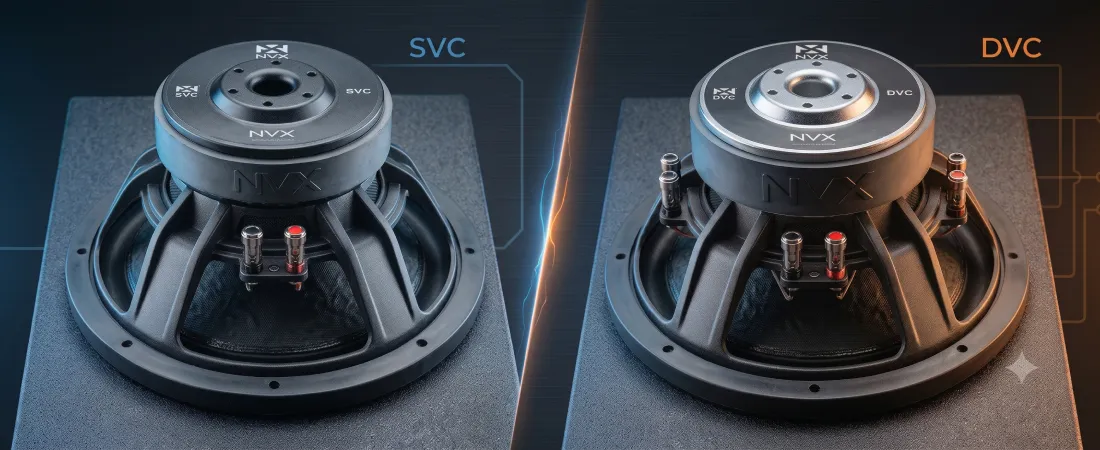
When shopping for a subwoofer, you will immediately encounter two terms: SVC (Single Voice Coil) and DVC (Dual Voice Coil). For beginners, this choice is often a major source of confusion. Many assume that a dual voice coil subwoofer is automatically “better,” plays louder, or handles more power than a single voice coil model.
In reality, from an acoustic and performance standpoint, the SVC and DVC versions of the same subwoofer are identical. The difference has nothing to do with sound quality; it is entirely about installation flexibility. Understanding how these configurations work is the only way to successfully match your subwoofers to your amplifier’s maximum clean output capability.
Phase 1: The Voice Coil as the Engine
To understand the difference, you must first understand what a voice coil does. The voice coil is the electromagnetic component that converts electrical signals from your amplifier into the mechanical motion that produces sound waves. Think of it as the engine that drives your subwoofer’s cone.
This tightly wound coil of wire sits inside the subwoofer’s magnetic gap, attached to the cone assembly. When your amplifier sends alternating current (AC) through the voice coil, it creates a changing magnetic field. This field interacts with the permanent magnet, forcing the coil—and therefore the cone—to move forward and backward to create bass notes.
Phase 2: Single Voice Coil (SVC) Subwoofers
A Single Voice Coil subwoofer features one continuous winding of wire around the cylinder (former). It has exactly one positive terminal and one negative terminal on the basket for speaker wire connection.
- The Impedance Limitation: Because there is only one coil, the speaker has a fixed electrical resistance, or impedance. If you buy an SVC 4-ohm subwoofer, it presents a 4-ohm load to your amplifier. There is no way to wire this individual subwoofer to change its resistance.
- Pros: Simple, straightforward wiring. It is nearly impossible for a beginner to wire an SVC sub incorrectly.
- Cons: Zero wiring flexibility. If you have an amplifier optimized to produce its maximum power at a lower load, a single SVC 4-ohm subwoofer will limit your power potential.
Phase 3: Dual Voice Coil (DVC) Subwoofers
A Dual Voice Coil subwoofer features two independent voice coils wound on the same former, each with its own positive and negative terminals. Each coil carries the same impedance rating, but wiring them together changes the subwoofer’s total impedance.
DVC subwoofers provide great installation flexibility because you can wire the coils in two different ways:
- Parallel Wiring (Halving Impedance): Wiring the positive terminals together and the negative terminals together. This cuts the impedance in half. For example, a DVC 4-ohm sub wired in parallel presents a 2-ohm load to your amplifier.
- Series Wiring (Doubling Impedance): Wiring the positive of one coil to the negative of the other coil. This doubles the impedance. For example, a DVC 4-ohm sub wired in series presents an 8-ohm load to your amplifier.
This wiring flexibility is incredibly helpful when matching one or more subwoofers to draw the maximum safe wattage from your amplifier. For a deeper understanding of these wiring methods, see our guide on Series vs. Parallel Wiring.
Phase 4: The Performance Myth and The One-Coil Warning
The most common myth in car audio is that DVC subwoofers handle more power or hit harder than SVC models. If you compare an SVC 4-ohm version of a subwoofer to a DVC 4-ohm version of the exact same model, their continuous RMS power ratings and physical materials are identical.
However, because DVC subwoofers have two separate sets of terminals, beginners often make a dangerous mistake: using only one of the two voice coils.
If you leave one voice coil disconnected, several negative things occur:
- Acoustic Distortion: The mechanical compliance of the driver is altered. The speaker’s total Q-factor (Qts) spikes significantly, turning a smooth, accurate response into a muddy, boomy “one-note” peak around 50Hz, while reducing output at ultra-low frequencies.
- Loss of Thermal Power Handling: Driving only half the motor assembly drastically reduces the speaker’s continuous thermal limits. The unused coil cannot dissipate enough heat on its own, risking rapid voice coil burnout.
Recommended Video Resources
Single vs Dual Voice Coil – Which is BEST?
An excellent visual demonstration explaining how voice coils work, the pros and cons of each, and how they affect your amplifier choice.
How To Wire Subwoofers
A practical, step-by-step tutorial showing how to make physical series and parallel connections on both SVC and DVC subwoofers.
Common Mistakes
- Running a DVC Subwoofer with One Coil Disconnected: Always wire both coils. If you only need a single 4-ohm load, buy an SVC 4-ohm subwoofer rather than leaving half of a DVC sub unwired.
- Assuming DVC Means “Stereo” Bass: Bass frequencies are non-directional and almost always mono. Never wire different amplifier channels (like left and right) to individual coils on a single subwoofer, as they will fight each other, causing extreme heat and distortion.
- Mixing SVC and DVC Subwoofers: Combining an SVC subwoofer and a DVC subwoofer in the same system. This will distribute power unevenly and create phase cancellation, resulting in weak, uneven bass response.
References
- Crutchfield Learning Center – Understanding Dual Voice Coil Subwoofers
- BestCarAudio.com – Why You Can’t Use Only One Coil on a DVC Subwoofer
- Sonic Electronix Learning Center – Series and Parallel Subwoofer Wiring