
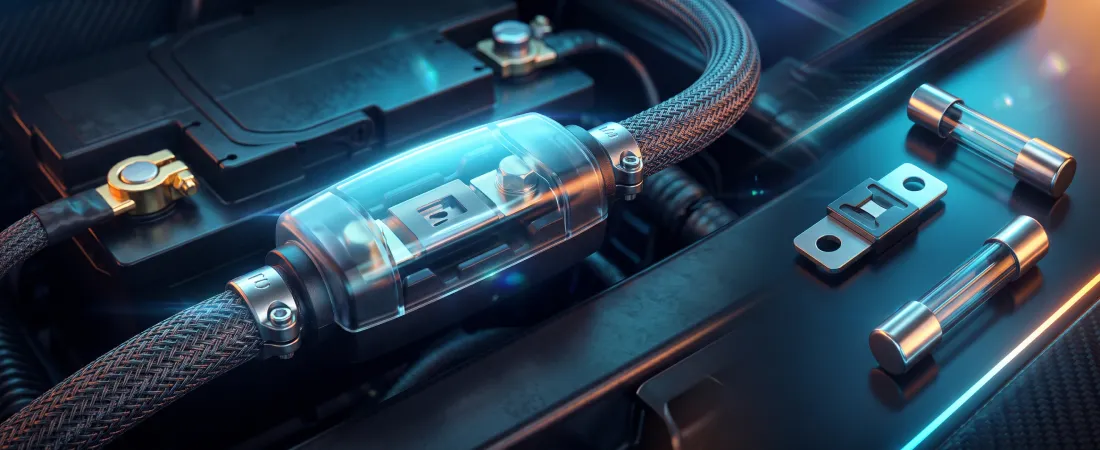
Fuses are the single most important safety component in a car audio electrical system. While many beginners assume a fuse is installed to protect their amplifier, its primary purpose is actually to protect the vehicle itself from catching fire during an electrical short circuit.
Understanding how to choose the correct fuse style, calculate the proper amperage rating, and position the fuse holder correctly along the power wire ensures that your system operates safely under heavy current demand without risking catastrophic electrical failure.
Why Fuses Are Mandatory in Car Audio
Automotive batteries store immense amounts of chemical energy. If a primary power wire insulation wears down against metal sheet metal or gets pinched under a seat, it creates a direct electrical short circuit. Without a fuse, current flows unrestricted, instantly heating the copper cable to thousands of degrees until the insulation melts, surrounding plastics ignite, and a vehicle fire begins.
A properly rated fuse acts as the intentional weak link in the electrical circuit. It contains a calibrated metal strip designed to melt rapidly and disconnect power harmlessly before the wire or vehicle harness reaches a dangerous temperature.
Main Power Wire Fuse Placement
The most crucial rule in car audio wiring is the physical location of the main power wire fuse holder:
- Distance Rule: The main fuse holder must be installed along the main positive cable within 12 to 18 inches of the battery terminal.
- Why Distance Matters: The section of wire between the positive battery post and the fuse holder remains completely unprotected. If a short circuit occurs in that short span, the fuse cannot interrupt current flow. Keeping this distance as short as possible minimizes fire risk.
If your system uses a distribution block in the rear of the vehicle to feed multiple amplifiers, each smaller branch wire extending from the block also requires its own dedicated fuse sized for that specific secondary wire gauge. Learn more about system layout in our car audio wiring overview.
Common Car Audio Fuse Types
Different fuse styles offer varying current capacities, physical mounting footprints, and internal electrical resistance:
AGU Fuses (Glass Cylinder)
AGU fuses feature a glass cylindrical body with metal end caps, typically rated between 10A and 80A. While common in basic entry-level wiring kits, AGU fuses are prone to vibration failure and high internal thermal resistance. They are generally obsolete for modern high-power systems.
Mini-ANL / AFS Fuses
Mini-ANL fuses use a compact blade-style design secured with set screws or bolts. They are rated from 20A up to 150A. Mini-ANL fuse holders offer low electrical resistance, excellent vibration tolerance, and compact dimensions, making them the industry standard for 8 AWG and 4 AWG power wire runs.
ANL Fuses (Heavy-Duty Bolt-On)
ANL fuses are large, heavy-duty wafer fuses bolted directly to solid brass posts, rated from 80A up to 300A+. Designed for high-current transfer, ANL fuses provide the lowest resistance and highest structural stability, making them mandatory for 1/0 AWG cables and high-output multi-amplifier builds.
Maxi Fuses
Maxi fuses are oversized traditional blade fuses widely used in automotive factory fuse blocks. While reliable up to 100A, their larger plastic housing requires wider inline holders compared to Mini-ANL designs.
How to Calculate the Correct Fuse Size
Fuses are sized to protect the power wire, not the equipment connected at the end of it. The fuse rating must never exceed the maximum safe current-carrying capacity (ampacity) of the specific wire gauge and conductor material used.
Step-by-Step Fuse Sizing Process:
- Determine Wire Ampacity: Check your cable’s rated capacity using the power wire size chart (accounting for Oxygen-Free Copper vs. Copper-Clad Aluminum).
- Determine Total Current Draw: Sum the manufacturer fuse ratings of all connected amplifiers or calculate total current draw based on continuous RMS output.
- Select the Fuse: Choose a fuse rating that is equal to or slightly higher than the system’s maximum current draw, but strictly lower than the wire’s maximum safe ampacity.
For example, if a 4 AWG Oxygen-Free Copper cable can safely carry 125A and your amplifier draws 80A at full output, an 80A to 100A Mini-ANL fuse provides ideal protection. You can review foundational rules in electrical basics.
Recommended Video Resources
Why is Car Audio Amplifier Fuse Placement Important? | Car Audio Q & A
Watch as Allyn and Brendan explain why it’s important to put the fuse and fuse holder less than 18″ from the car battery. They explain what could happen if you don’t use a fuse or fuse holder and if you put the fuse and fuse holder more than 18″ from the battery.
Fuses EXPLAINED! What size do YOU need & MORE!
What size fuse do you need for your amplifier? How close should the fuse be to the battery? Do you need a fuse if your amplifier already has one built in? How do you fuse multiple amplifiers? I answer these questions and more in this video all about car audio fuses on how to use them for a car stereo system.
Common Mistakes
- Placing the Fuse Near the Amplifier: Installing the inline fuse in the trunk near the amplifier leaves 15+ feet of primary power cable completely unprotected.
- Fuses That Are Too Large for the Wire: Installing a 250A fuse on a thin 8 AWG wire means the wire will melt and catch fire long before the fuse ever blows.
- Bypassing Fuses with Solid Metal Bars: Replacing a blown fuse with a copper bolt, wire, or solid foil to bypass thermal protection creates an extreme fire hazard.
- Forgetting Secondary Fuses at Distribution Blocks: Stepping down from a main 1/0 AWG wire to a 4 AWG wire at a rear distribution block without fusing the smaller 4 AWG branch wires.
- Using Cheap AGU Holders in High-Vibration Areas: Using spring-loaded AGU holders that loosen over time, causing high resistance, arcing, and melted plastic housings. Learn how to prevent voltage drops in voltage drop explained.
References
- Crutchfield Learning Center – How to Choose the Right Fuse for Car Audio
- JL Audio School of Sound – Understanding Electrical Resistance and Safe Circuit Protection