
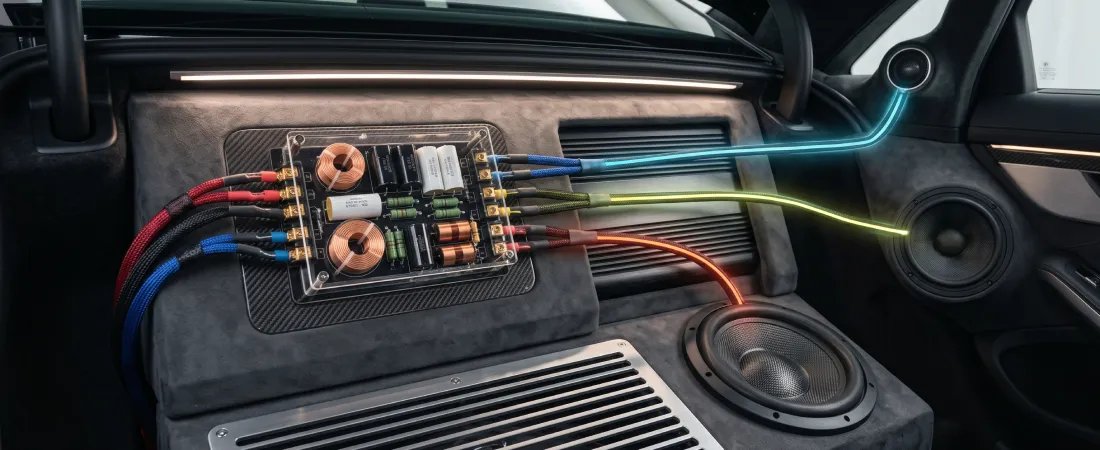
In a car audio system, music is not just a single continuous stream of sound; it is a complex spectrum of electrical frequencies ranging from deep sub-bass (20Hz) to ultra-high treble (20,000Hz). No single speaker is physically capable of reproducing this entire range cleanly.
This is where a crossover steps in. A crossover acts as an audio traffic controller, directing high notes to your tweeters, midrange frequencies to your woofers, and low bass to your subwoofer. Without proper crossovers, a system will suffer from severe distortion, overlapping frequencies, and immediate speaker damage.
Phase 1: High-Pass, Low-Pass, and Bandpass Filters
At the heart of any crossover are specific electronic filters designed to block unwanted frequencies while letting desired ranges pass through safely.
- High-Pass Filter (HPF): A high-pass filter blocks low-frequency bass notes and only allows high-frequency notes to pass. HPFs are critical for protecting small speakers like tweeters and door speakers from the physical strain of trying to reproduce deep bass.
- Low-Pass Filter (LPF): A low-pass filter does the exact opposite. It blocks high-frequency treble and only allows low-frequency bass to pass. This is used on subwoofers to prevent them from trying to play vocals or instruments, which would make the bass sound muddy and distorted.
- Bandpass Filter (BPF): A bandpass filter combines both an HPF and an LPF. It creates a specific frequency window, blocking both the extremely high and extremely low notes. This is primarily used for dedicated midrange drivers in three-way systems to isolate their performance between the woofer and the tweeter.
Phase 2: Understanding Crossover Slopes and Rolloff
A crossover is not a brick wall; it does not cut off frequencies instantly at a specific number. Instead, it acts like a ramp, gradually reducing the volume of the blocked frequencies. This rate of reduction is called the slope, which is measured in decibels (dB) per octave.
- 6dB/Octave (1st Order): A very gentle slope. Frequencies outside the target range are turned down slowly, which can sometimes lead to frequency overlap between adjacent speakers.
- 12dB/Octave (2nd Order): The most common standard for passenger car systems. It provides a clean, predictable transition without adding complex phase shifts.
- 24dB/Octave (4th Order): A steep slope that cuts off unwanted frequencies quickly, offering maximum protection for delicate drivers and creating a highly focused soundstage.
Phase 3: Passive vs. Active Crossovers
Crossovers are divided into two primary structural types, determined by where they sit in the audio signal path. To understand this concept deeply, read our guide on Passive vs. Active Systems.
- Passive Crossovers: These operate on high-level, amplified signals and are installed between the amplifier and the speakers. They do not require an independent power source because they use physical passive components, like coils (inductors) to block treble and capacitors to block bass. They are simple to install but offer no adjustments once wired.
- Active Crossovers: These operate on low-level preamp signals and are installed before the amplifier. They require dedicated 12V power, ground, and turn-on connections. Active crossovers allow you to adjust the crossover points and slopes on the fly, optimizing the output of each speaker to suit the vehicle’s specific cabin acoustics.
Phase 4: Setting Your Baseline Crossover Points
Choosing the correct crossover frequencies is vital to protecting your hardware. While every vehicle and speaker is different, these standard baseline settings are highly effective for daily listening systems:
| Speaker Type | Filter Type | Typical Baseline Setting | Purpose |
|---|---|---|---|
| Subwoofer | Low-Pass (LPF) | 80Hz | Keeps vocals out of the subwoofer to prevent muddiness. |
| Door Speakers | High-Pass (HPF) | 80Hz | Blocks deep bass to prevent physical cone damage. |
| Tweeters | High-Pass (HPF) | 3,000Hz (3kHz) | Blocks midrange and bass from melting the delicate voice coil. |
For a deeper dive into adjusting these individual values, consult our HPF and LPF Explained resource.
Recommended Video Resources
Passive vs Active Crossovers Explained
A comprehensive breakdown of the trade-offs, wiring configurations, and installation demands of both active and passive crossovers.
How Do Crossover Filters Behave?
A technical video illustrating how different crossover slopes and alignments protect speakers and shape sound.
Common Mistakes
- Setting the Tweeter HPF Too Low: Sending frequencies below 2,000Hz (2kHz) to a small tweeter will quickly overheat its tiny voice coil, causing immediate thermal failure.
- Overlapping Crossover Points: Setting your subwoofer LPF to 120Hz and your door speaker HPF to 60Hz. This causes both speakers to play the 60Hz–120Hz range simultaneously, resulting in boomy, muddy, and uncontrolled bass.
- Forgetting to Set the Crossover Type on the Amp: Many amplifiers feature a switch to select flat (full range), HPF, or LPF. Leaving this switch on “Full” while connecting a tweeter will destroy it the moment the volume is turned up.
References
- Sonic Electronix Learning Center – Passive Crossovers Explained: What They Do and Why They Matter
- Crutchfield Learning Center – How to Choose a Car Audio Crossover
- BestCarAudio.com – What the Crossover Settings on Your Amplifier Really Do