
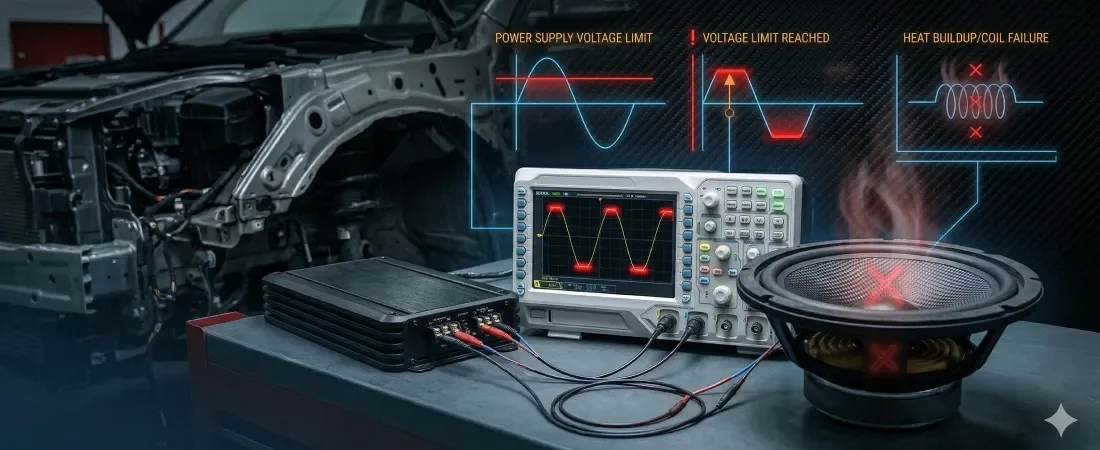
In car audio, “clipping” is the most common reason speakers and subwoofers fail. Most beginners assume that a speaker “blows” because the amplifier is too powerful. In reality, speakers are more often destroyed by an underpowered amplifier being pushed beyond its limits. Understanding clipping is the key to achieving a system that plays loudly and stays reliable for years.
Phase 1: Visualizing the Signal (Sine vs. Square)
An audio signal travels as alternating current (AC) in the form of a sine wave. In a clean signal, the peaks and troughs of the wave are smooth and rounded. Clipping occurs when an amplifier is asked to produce more voltage than its power supply can provide.
Instead of following the smooth curve of the music, the amplifier “clips off” the tops and bottoms of the wave. This transforms the smooth sine wave into a square wave pattern. Visually, the rounded hills become flat plateaus. Auditorily, this sounds like harshness, fuzz, or crackling in the music, especially during loud passages.
Phase 2: The Thermal Reality (Why Clipping Kills)
The primary danger of clipping is not the distorted sound, but the heat. In a normal AC signal, the voice coil of a speaker is constantly moving back and forth, which allows air to flow and cool the coil.
When a signal clips, the waveform stays at its maximum voltage for a longer period (the plateau). During these flat spots, the signal behaves like DC (Direct Current). The speaker cone stops moving for a fraction of a second while the voice coil remains fully energized. This converts 100% of the amplifier’s energy into heat rather than motion, quickly melting the protective varnish on the voice coil and leading to thermal failure.
Phase 3: The Root Causes (Gain vs. Volume)
Clipping is rarely the fault of the speaker; it is a system-level issue typically caused by one of three things:
- Improper Gain Setting: Mistaking the amplifier gain for a volume control. If set too high, the amp reaches its limit with very little input signal.
- Voltage Drops: If your vehicle’s electrical system is weak, the amplifier’s power supply can’t maintain the necessary voltage, causing the signal to “crash” into the ceiling and clip.
- Source Distortion: If the head unit is turned up to a level where its internal processor distorts, it sends a clipped signal to the amp. Amplifying a dirty signal only makes the danger worse for your speakers.
Phase 4: Detection and Prevention
Identifying clipping by ear can be difficult, especially with subwoofers which often fail “silently.” Professional installers use specific tools to ensure the signal flow remains clean:
- Oscilloscope: Provides a real-time visual of the waveform, showing exactly when the sine wave begins to flatten.
- Multimeter Method: A safer way for beginners to set gains by using math to target a specific AC voltage. Learn more in our Gain Setting Guide.
- Clip Indicators: Many modern amplifiers include an LED that flashes when the signal begins to square off.
Recommended Videos
How to set Filters and Gains on a Car Audio Amp to avoid clipping
Bass Cuts Out at High Volume – Amp Shuts Down
Common Mistakes
- Assuming Clipping Only Happens at Max Volume: You can clip an amplifier at low volume if the gain is poorly matched to the head unit.
- Using Bass Boost to Fix Weak Bass: Bass boost adds a massive amount of “gain” to specific frequencies, forcing the amp to clip almost immediately.
- Buying High-Wattage Speakers to “Fix” Distortion: Clipping is an amplifier behavior. A 1,000W speaker will still burn out if it receives a 100W clipped signal.
References
- Sonic Electronix Learning Center – Why Clipping Causes Subwoofers to Overheat
- JL Audio School of Sound – Understanding Audio Distortion and Clipping
- Crutchfield Learning Center – Speaker and Amplifier Wattage Ratings Explained
- BestCarAudio.com – The Importance of Low Gain Settings