
Tuning is where good car audio systems become great—or where expensive systems fall apart. Most tuning problems aren’t caused by bad equipment, but by misunderstanding what tuning controls actually do.
Mistake #1: Using Gain as a Volume Control
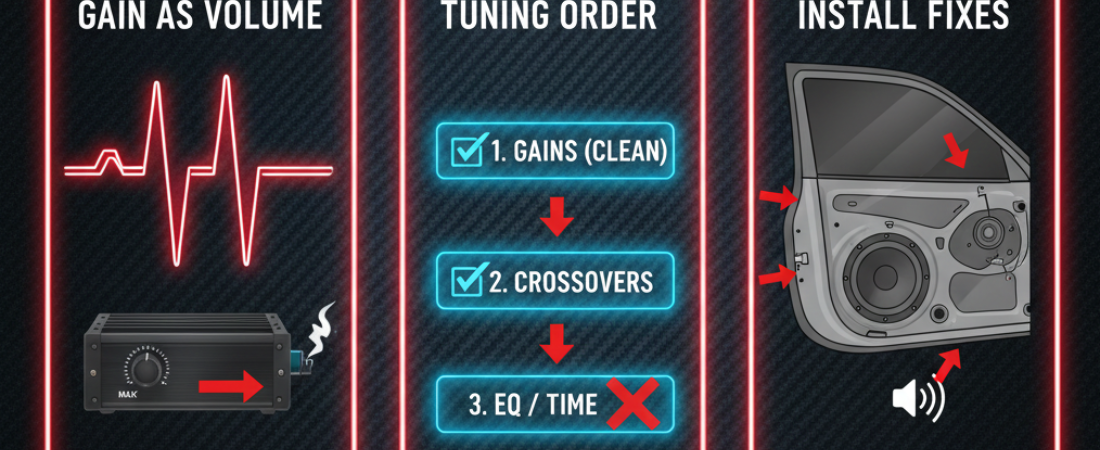
Amplifier gain does not increase clean output. It matches the amplifier’s input sensitivity to the source signal. Turning gain up too far causes clipping, even if distortion isn’t immediately obvious.
Learn more in What Gain Actually Does, Why Gain Is Not Volume, and What Is Clipping.
Mistake #2: Tuning Before Setting Gains
EQ, crossovers, and DSP settings should never be adjusted before gains are set correctly. If the signal is already distorted, tuning adjustments only amplify the problem.
Correct order:
- Set gains cleanly
- Set crossovers
- Adjust EQ
- Apply time alignment (if used)
See Setting Gains (Multimeter Method) and Signal Flow Explained.
Mistake #3: Overusing EQ
Excessive EQ boosting increases distortion, reduces headroom, and raises thermal stress on speakers. Good tuning focuses on cutting problem areas before boosting anything.
Learn proper technique in Basic EQ Principles and Why Tuning Matters.
Mistake #4: Incorrect Crossover Settings
Crossovers protect speakers and define how frequencies are divided. Incorrect settings can cause muddy sound, weak midbass, or speaker damage.
- HPF set too low on door speakers
- Too much overlap between subs and mids
- Using steep slopes without understanding phase
See Crossovers Explained, HPF / LPF Explained, and Crossover Slopes Explained.
Mistake #5: Ignoring the Vehicle Environment
No amount of tuning can fix untreated doors, rattling panels, air leaks, or poor speaker mounting. Tuning should always come after proper installation.
See Door Treatment & Sound Deadening and Sealing Doors for Better Sound.
Mistake #6: Copying Someone Else’s Settings
Every vehicle is different. DSP and EQ settings from another car should be treated as a starting point only.
Learn why in DSP vs No DSP and Time Alignment Explained.
Mistake #7: Tuning at Unsafe Volume Levels
Tuning at extreme volume hides distortion and leads to inaccurate adjustments. Tune at moderate, repeatable listening levels and verify behavior at higher volume later.
Mistake #8: Skipping Tuning Entirely
Even basic systems benefit from proper gain structure, correct crossovers, and minimal EQ. Tuning is not optional if you want reliable, clean sound.