
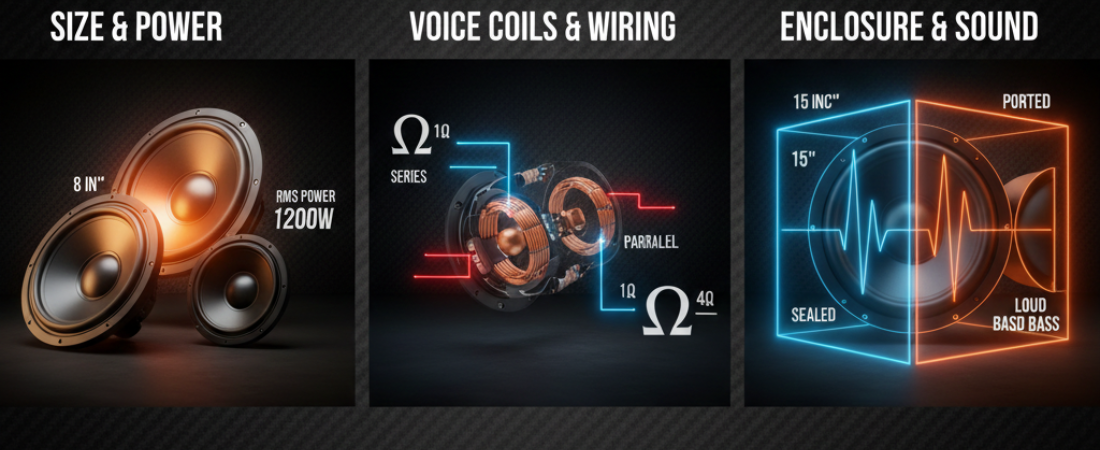
Subwoofers exist to reproduce low-frequency sound that standard speakers cannot handle efficiently. Bass frequencies require more air movement, and subwoofers are designed specifically for that task.
A well-designed subwoofer system adds impact, depth, and balance. A poorly designed one creates distortion, rattles, and blown equipment.
What a Subwoofer Does
Subwoofers handle low frequencies, typically from about 20 Hz up to 80–120 Hz depending on the system. They reduce strain on other speakers and improve overall clarity.
This role is closely tied to Signal Flow Explained and Crossovers Explained.
Subwoofer Size and Cone Area
Common subwoofer sizes include 8″, 10″, 12″, 15″, and larger. Larger subs can move more air, but size alone does not determine performance.
Enclosure design, excursion capability, and vehicle size matter just as much.
Power Handling and RMS Ratings
Subwoofers are rated using RMS power, which reflects continuous power handling. However, most subwoofer failures are caused by clipping rather than excessive clean power.
See RMS vs Peak Power, What Is Clipping, and What Gain Actually Does.
Single vs Multiple Subwoofers
Adding more subwoofers increases cone area and potential output but also increases space, cost, and electrical demand.
Impedance and Voice Coils
Subwoofers are available in single voice coil (SVC) and dual voice coil (DVC) configurations. Voice coil choice affects final impedance and amplifier compatibility.
Learn more in SVC vs DVC Explained and Series vs Parallel Wiring.
Why Enclosures Matter
The enclosure controls how a subwoofer behaves. Choosing the wrong enclosure can make a great subwoofer perform poorly.
Start with Sealed vs Ported Boxes and Box Size vs Sound.
Placement and Orientation
Subwoofer placement and orientation affect cabin gain, bass response, and rattles.
See Downfiring vs Forward-Firing Subs.
Common Subwoofer Mistakes
- Choosing subs before defining system goals
- Ignoring enclosure requirements
- Wiring without verifying final impedance
- Using gain to compensate for poor design
Recommended Videos
Subwoofer Basics Explained
Sealed vs Ported Enclosures
References
- Sonic Electronix Learning Center – subwoofer fundamentals and enclosure considerations
- Crutchfield – how subwoofers work and why enclosures matter
- JL Audio – subwoofer design and low-frequency reproduction basics