
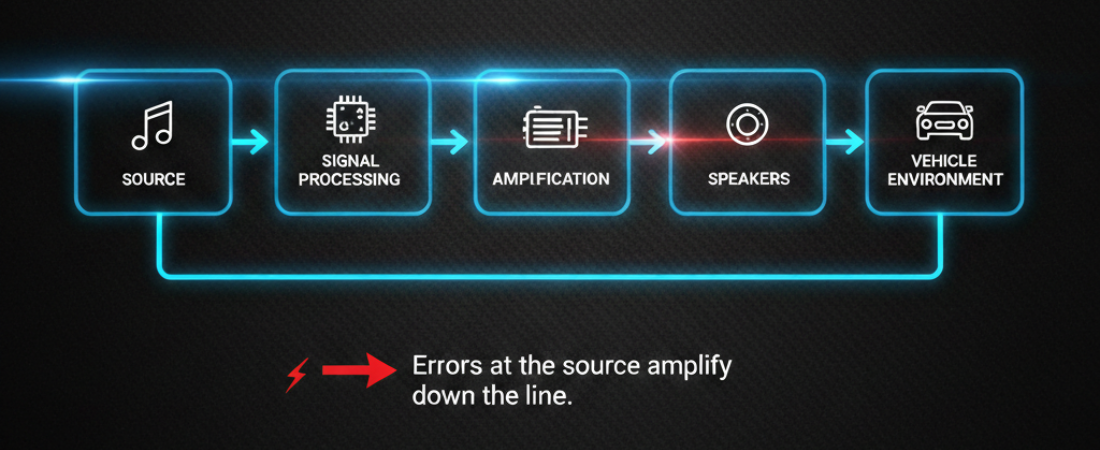
Signal flow describes the path audio takes from the moment it leaves the source until it becomes sound in your vehicle. Understanding signal flow is critical because every tuning, wiring, and equipment decision depends on it.
Most car audio problems – distortion, noise, blown speakers, weak output – happen when signal flow is misunderstood or broken.
What Is Signal Flow?
Signal flow is the order in which audio travels through your system:
Source → Processing → Amplification → Speakers → Vehicle Environment
Each stage affects everything that comes after it. Problems introduced early in the chain cannot be fixed later. This system-based thinking is explained further in Car Audio 101.
Step 1: The Source
The source is where the audio signal originates. Common sources include factory head units, aftermarket radios, smartphones, media players, and DSP inputs.
The source determines signal quality, output voltage, and noise floor. If the source signal is distorted or limited, no amount of amplification or tuning will fix it.
This is why factory systems often require proper integration before upgrading speakers or amplifiers.
Step 2: Signal Processing
Signal processing controls what frequencies go where and how they are shaped. Processing may include:
- Crossovers (HPF / LPF)
- Equalization (EQ)
- Time alignment
- Level matching
Processing may occur in a head unit, amplifier, or standalone DSP, but it must happen before amplification. Once a signal is clipped or distorted, processing cannot remove the damage.
See Why Tuning Matters and DSP vs No DSP for deeper explanations.
Step 3: Amplification
Amplifiers increase signal voltage so speakers can move properly. Amplifiers do not create sound quality — they reveal it.
Improper gain structure is one of the most common signal flow mistakes. Gain must match the incoming signal, not act as a volume control.
Learn more in What Gain Actually Does, RMS vs Peak Power, and What Is Clipping.
Step 4: Speakers and Subwoofers
Speakers convert electrical energy into sound. Mechanical limits, enclosure design, and proper filtering all matter here.
If speakers receive frequencies they cannot handle, damage occurs even at moderate power levels. This is why proper crossovers must be set before amplification.
Step 5: The Vehicle Environment
The vehicle itself is part of the system. Door panels, enclosures, cabin size, reflections, and road noise all affect sound.
Two identical systems can sound completely different depending on installation quality.
See Door Treatment & Sound Deadening and Planning an Install.
Common Signal Flow Mistakes
- Using gain as a volume control
- Applying EQ after distortion occurs
- Sending full-range signals to small speakers
- Stacking processing across multiple devices without a plan
- Upgrading amplifiers before fixing the source
Recommended Videos
Car Audio Signal Flow Explained
Why Gain Is Not Volume
References
- Sonic Electronix Learning Center – system layout and signal chain concepts
- Crutchfield – understanding signal paths in car audio systems
- Audio Control – gain structure and signal integrity education