
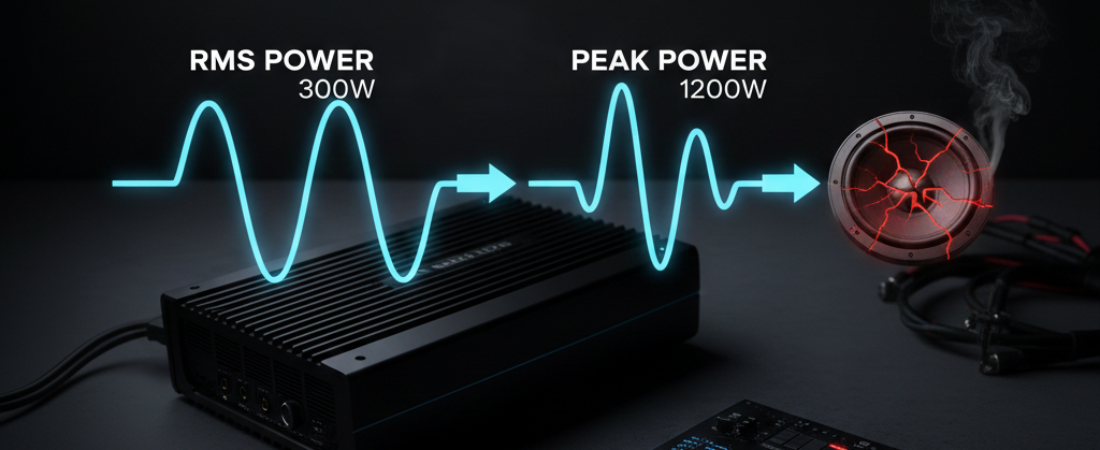
Power ratings are one of the most confusing parts of car audio. You’ll see speakers and amplifiers advertised with huge wattage numbers like “1000W MAX” or “2000W PEAK,” but those numbers often have little to do with real performance.
To build a system that sounds good and stays reliable, you need to understand the difference between: RMS power (the rating that matters) and Peak/Max power (mostly marketing).
What Is RMS Power?
RMS (Root Mean Square) power is the amount of power a speaker can handle or an amplifier can produce continuously without overheating or failing.
RMS power is the number you should use for matching amplifiers to speakers, matching amplifiers to subwoofers, estimating electrical load, and system design decisions.
If you remember one thing from this page: RMS is the only power rating that matters for system design.
For related fundamentals, see Amplifier Basics and Matching Amps to Speakers.
What Is Peak (Max) Power?
Peak power (often called “Max power”) is the highest short burst of power a component might survive for a fraction of a second. It is not sustainable and is often inflated for marketing.
Peak ratings should not be used to design a system.
Why Peak Power Ratings Mislead People
Mistake #1: Buying gear based on big numbers
A speaker that says “1000W MAX” may only be 250W RMS.
Mistake #2: Assuming you need massive power
Many systems get loud with far less power than people expect, especially when speakers are efficient (Speaker Sensitivity Explained), the system is tuned correctly (Why Tuning Matters), and the enclosure is designed properly (Sealed vs Ported Boxes).
RMS Power Depends on Impedance
Amplifier RMS power is always tied to impedance (ohms). For example:
- 500W RMS @ 2 ohms
- 300W RMS @ 4 ohms
If you change wiring configuration, you can change amplifier output dramatically. This is why you must understand Understanding Ohms & Impedance and Series vs Parallel Wiring.
Does More RMS Power Mean Louder?
Not always. Loudness depends on speaker sensitivity, the vehicle environment, installation quality, enclosure design, and tuning.
For deeper context, read Speaker Sensitivity Explained and Car Audio 101 – The Mental Model.
Can Too Much Power Blow Speakers?
Power alone usually isn’t what kills speakers. Most failures come from clipping, incorrect gain setting, mechanical over-excursion, bad enclosure design, or electrical problems.
See What Is Clipping, Why Speakers Blow, and Why Bigger Amps Don’t Kill Speakers.
How to Use RMS Ratings Correctly
For speakers (mids/tweeters)
- Choose an amp that can provide clean RMS power in the safe range
- Use crossovers correctly (Crossovers Explained)
For subwoofers
- Match amplifier RMS to subwoofer RMS at the correct impedance
- Use the correct enclosure type and volume
Start with Matching Amp Power to Subwoofers, Subwoofer Basics, and Sealed vs Ported Boxes.
Recommended Videos
RMS Watts vs Peak and Max Watts, Amplifier Power Explained
Why Gain Is Not Volume (Clipping & Gain Basics)
References
- Sonic Electronix Learning Center – amplifier/speaker matching and car audio fundamentals
- Crutchfield – understanding amplifier power ratings and system design
- Best Car Audio – real-world explanation of gain and clipping