
Equalization (EQ) is one of the most powerful tools in car audio—and one of the easiest ways to make a system sound worse if it’s misused.
EQ does not create sound quality. It reshapes frequency balance to compensate for speaker limitations, vehicle acoustics, installation constraints, and listener preference.
EQ is part of the tuning process described in Why Tuning Matters and should never be the first adjustment you make.
What EQ Actually Does
EQ adjusts the level of specific frequency ranges. Boosting increases output in that range, while cutting reduces it.
In car audio, EQ may be applied through head units, DSPs, or some amplifiers.
Cut Before You Boost
One of the most important EQ rules is simple:
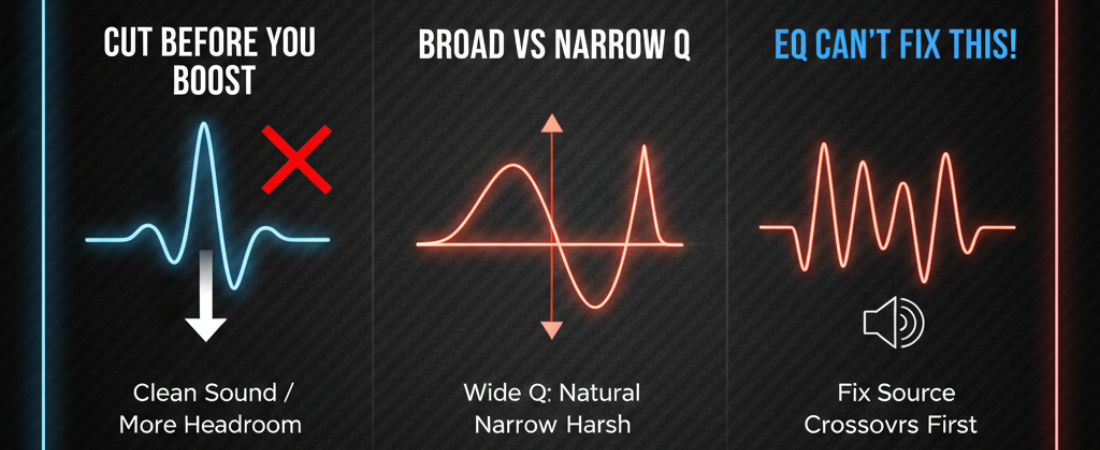
Cut before you boost.
Boosting increases amplifier demand and raises the risk of distortion and clipping. Cutting unwanted frequencies often produces cleaner results.
This directly relates to What Is Clipping and What Gain Actually Does.
Broad Adjustments Sound More Natural
Wide EQ changes usually sound smoother and more natural than narrow boosts. Extremely narrow adjustments often exaggerate resonances and listening fatigue.
Common Frequency Ranges
- 20–60 Hz: Sub-bass depth and impact
- 60–200 Hz: Mid-bass punch and warmth
- 200 Hz – 2 kHz: Core midrange and vocals
- 2–5 kHz: Presence and clarity
- 5–15 kHz: High-frequency detail and air
EQ Cannot Fix Mechanical Problems
EQ should never be used to compensate for:
- Poor speaker mounting
- Unsealed doors
- Incorrect crossover settings
- Improper gain structure
Before EQ, confirm gains (Setting Gains – Multimeter Method), crossovers (Crossovers Explained), and installation quality.
Factory EQ vs DSP EQ
Factory systems often apply automatic EQ and loudness curves. DSP-based EQ offers far greater control and precision.
See DSP vs No DSP for a deeper comparison.
Common EQ Mistakes
- Boosting everything that sounds weak
- Making EQ changes at high volume
- Using EQ to compensate for clipping
- Copying someone else’s EQ settings
Recommended Videos
Tuning your car stereo – Head Unit Equalizer – No DSP! PROCESS EXPLAINED
What Causes Distortion? An Audio Engineer Explains Speaker Distortion
References
- Sonic Electronix Learning Center: Car audio tuning fundamentals and EQ usage
- Crutchfield: Understanding car audio equalizers
- miniDSP: Practical notes on EQ, gain structure, and distortion
- Best Car Audio: Why cutting frequencies often sounds better than boosting