
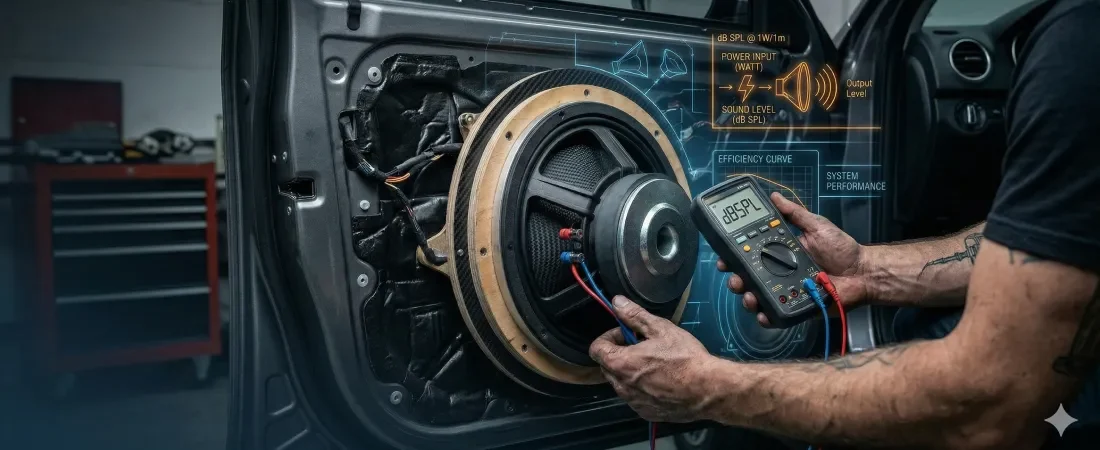
In the world of car audio, beginners often focus exclusively on wattage, assuming a “500-watt” speaker is naturally better than a “100-watt” model. However, wattage only tells you how much thermal energy a speaker can handle before failing; Sensitivity tells you how much sound it actually produces. Understanding this fundamental is the only way to ensure your speakers match your power source, whether you are using a 10-watt factory radio or a 1,000-watt competition amplifier.
Phase 1: Decoding the Rating (The 1W/1M Standard)
Sensitivity (often used interchangeably with “efficiency”) measures the Sound Pressure Level (SPL) a speaker produces with a specific input. The industry standard is to place a calibrated microphone exactly 1 meter away and feed the speaker exactly 1 watt of power.
The resulting number is expressed in decibels (dB):
- Low Sensitivity (80–84 dB): Common in heavy-duty subwoofers with thick surrounds. These require massive “muscle” from an amplifier to move the cone effectively.
- Average Sensitivity (87-89 dB): Most standard aftermarket speakers fall into this range.
- High Sensitivity (90 dB+): These are the “cheat code” for getting loud volume out of low-powered factory head units.
Phase 2: Evaluating the Math (The 3dB Rule)
In car audio, the relationship between power and volume is logarithmic. The “3dB Rule” states that for every 3 dB increase in sensitivity, the speaker requires half the power to reach the same volume level.
For example, if you compare an 87 dB speaker to a 90 dB speaker, the 87 dB speaker would need 100 watts of power to match the volume that the 90 dB speaker produces with only 50 watts. Because factory stereos typically only output 10–15 watts RMS, choosing a high-sensitivity speaker (92 dB+) is essential for maintaining clarity and volume without adding an external amplifier.
Phase 3: The Measurement Trap (1W/1m vs. 2.83V)
When reviewing spec sheets, you must verify the testing voltage. Many manufacturers use the 2.83V/1m standard because it can make their numbers look 3 dB higher than they actually are on paper.
In an 8-ohm home audio speaker, 2.83V equals exactly 1 watt. However, most car speakers are 4 ohms. When you apply 2.83V to a 4-ohm load, you are actually pushing 2 watts of power. Because the speaker is receiving double the power, a 2.83V rating will usually be 3 dB higher on the box than a 1W/1m rating for the exact same speaker. Always compare “apples to apples” by checking the measurement unit.
Phase 4: System Matching (Application)
Your choice of sensitivity should be dictated by your Signal Flow and your specific power source.
| Power Source | Recommended Sensitivity | Why it Works |
|---|---|---|
| Factory Head Unit | 90 dB+ | Maximizes volume on limited 10-15W RMS power. |
| Aftermarket Head Unit | 88–92 dB | Balances clarity and efficiency for moderate power. |
| External Amplifier | 85–88 dB | Allows for heavier, accurate cone materials; the amp provides the “muscle.” |
| High-Power SPL | 92 dB+ | Designed for extreme efficiency at high wattage. |
Recommended Video Resources
Speaker Sensitivity Explained (QualityMobileVideo)
BS Speaker Sensitivity Ratings (Erin’s Audio Corner)
Speaker Sensitivity Explained (Why Your Amp Struggles)
Common Mistakes
- Buying Low-Sensitivity Speakers for a Factory Radio: Using an 83 dB speaker on 10 watts of factory power will result in a quiet, flat, and disappointing sound.
- Assuming High Sensitivity Equals High Quality: Sensitivity measures volume, not accuracy. Many top-tier SQ speakers have lower sensitivity because their heavier, superior materials provide more accurate bass response.
- Ignoring the Impedance Context: Comparing a 2-ohm speaker’s 2.83V rating to a 4-ohm speaker’s 1W/1m rating. Check the specs closely before buying.
References
- Sonic Electronix Learning Center – Power Matching and Sensitivity Fundamentals
- Crutchfield Learning Center – Detailed guides on speaker sensitivity vs. power matching
- BestCarAudio.com – Scientific analysis of speaker efficiency and Thiele/Small parameters
- JL Audio School of Sound – Technical resources for matching amplifiers to speaker loads