
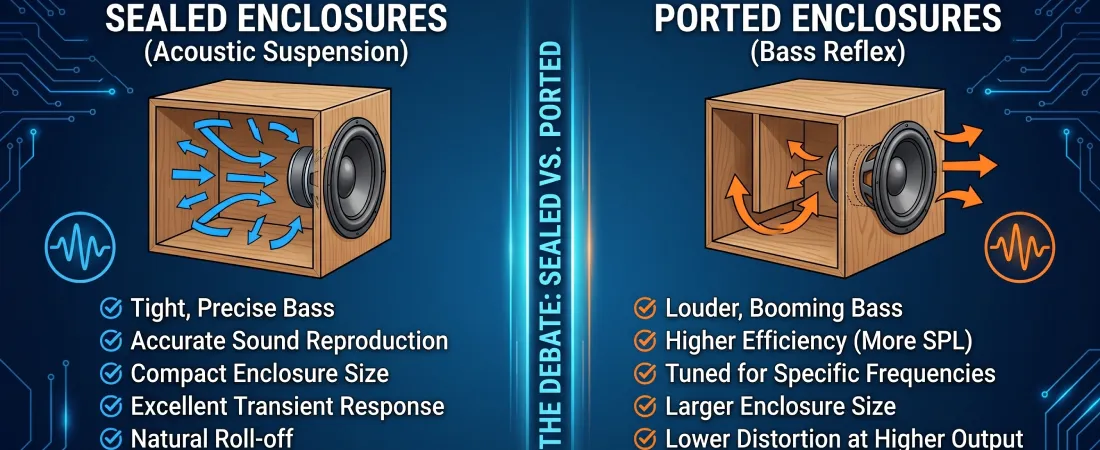
In car audio, the “best” subwoofer is only as good as the box it sits in. The enclosure is a functional component of the system that manages the air pressure created by the back of the speaker cone. Most enthusiasts fall into two camps: those who prefer the “tight” and accurate response of a sealed box, and those who want the “thundering” and efficient output of a ported box.
Phase 1: Sealed Enclosures (The Acoustic Suspension)
A sealed enclosure is an airtight cabinet. When the subwoofer moves forward and backward, the air inside acts like a shock absorber (acoustic suspension). This “cushion of air” provides constant resistance to the cone, ensuring it stops and starts with extreme precision.
- Bass Characteristics: Precise, “tight,” and articulate. Ideal for rock, jazz, and classical music.
- Roll-Off: Sealed boxes have a shallow roll-off (12dB/octave), which often complements “cabin gain” for a flat, natural response.
- Size: Compact design that fits easily in smaller vehicles or space-constrained trunks.
Phase 2: Ported Enclosures (The Bass Reflex)
A ported (or vented) enclosure includes a specifically calculated opening or “port” that allows air to move in and out of the box. This design uses the sound waves from the back of the cone to reinforce the waves from the front, tuning the enclosure to a specific frequency.
- Bass Characteristics: Thundering, loud, and impactful. Preferred for Hip-Hop, EDM, and Rap.
- Efficiency: Ported boxes produce more volume using the same amount of power and provide better cooling for the subwoofer’s voice coil.
- Size: These require much larger cabinets to accommodate the port and the necessary internal airspace.
Phase 3: The Technical Trade-offs
Choosing between these two isn’t just about volume; it involves understanding the electrical and mechanical limits of your system.
| Feature | Sealed Box | Ported Box |
|---|---|---|
| Accuracy | High (Tight/Precise) | Moderate (Boomy/Forceful) |
| Efficiency | Low (Needs more power) | High (Louder on less power) |
| Roll-Off Slope | Shallow (12dB/octave) | Steeper (24dB/octave) |
| Mechanical Control | Constant (Air cushion) | Low below tuning frequency |
The Subsonic Filter Rule: In a ported box, the subwoofer loses mechanical control below the port’s tuning frequency. To prevent damage, a subsonic filter on your amplifier is mandatory.
Recommended Videos
The Great Subwoofer Debate (Williston Audio Labs)
Sealed vs Ported Physics (QualityMobileVideo)
Common Mistakes
- Ignoring Box Size vs. Sound: An undersized box will ruin the performance of even the best subwoofer.
- Improper Port Tuning: Poorly calculated ports cause air noise (“chuffing”) and can lead to speaker failure. See our Port Tuning Basics for more info.
- Wrong Speaker Choice: Not all subwoofers are suitable for ported boxes. Always check manufacturer T/S parameters first.
References
- Sonic Electronix Learning Center – Sealed vs Ported Subwoofer Boxes
- Crutchfield Learning Center – Sealed or Ported Subwoofer Enclosures
- BestCarAudio.com – The Science Behind Subwoofer Enclosures
- MTX Audio Library – Vented vs Sealed Subwoofer Enclosures