
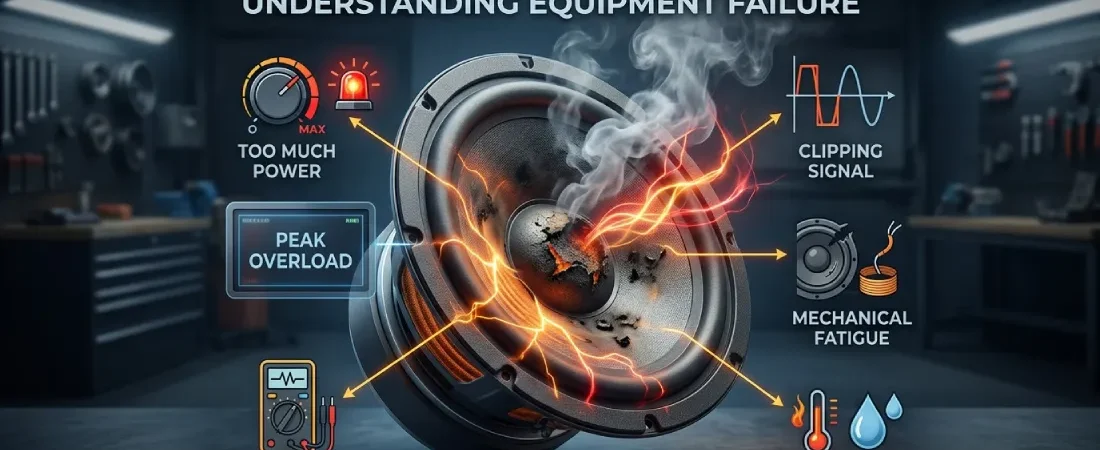
In car audio, the phrase “I blew my speakers” is common, but the actual mechanics of the failure are often misunderstood. Most beginners assume that having an amplifier with “too much power” is the primary culprit. While overpowering is a factor, most speakers fail due to specific electrical or mechanical stresses caused by poor system calibration. Understanding these two types of failure-thermal and mechanical-is the first step toward building a reliable high-performance system.
Phase 1: Thermal Failure (The “Burned” Coil)
Thermal failure is the most common way a speaker dies. Every speaker has a voice coil-a thin wire wrapped around a cylinder. As electricity flows through this wire, it generates heat. Under normal conditions, the motion of the speaker cone acts like a fan, pushing air over the coil to keep it cool. Failure occurs when the heat generated by the electricity exceeds the coil’s ability to dissipate it. This usually results in the protective varnish on the wire melting, causing the coil to short-circuit or “freeze” in the magnetic gap. This is why it is critical to understand the relationship between clipping and thermal buildup.
- The Cause: Often results from signal distortion or ignoring RMS power ratings.
- The Sign: A distinct “burning plastic” smell coming from the speaker or a total loss of sound.
Phase 2: Mechanical Failure (Over-Excursion)
Mechanical failure happens when the physical parts of the speaker are pushed beyond their structural limits. This is known as exceeding Xmax (maximum linear excursion). Unlike thermal failure, which is about heat, mechanical failure is about movement. When a speaker is forced to move too far, several things can happen:
- Torn Surround or Spider: The flexible parts that hold the cone in place rip under the stress.
- Bottoming Out: The voice coil physically slams into the back plate of the magnet assembly, often causing a loud “clacking” sound.
- Disconnected Lead Wires: The small tinsel leads that carry power to the coil may snap due to violent, uncontrolled movement.
Phase 3: The Frequency Mismatch
Speakers are specialized tools. A tweeter is designed to move very fast over a tiny distance, while a subwoofer is designed to move a large volume of air slowly. A frequent cause of “blown” speakers is asking a driver to play frequencies it wasn’t built for. This is where Signal Flow and proper crossover settings become vital. If you send deep bass signals to a small door speaker without using a crossover, the cone will attempt to move further than it mechanically can. This leads to immediate mechanical failure or rapid thermal buildup because the speaker is “straining” to produce notes it cannot physically execute.
Phase 4: Prevention through Calibration
Protecting your speakers is a matter of system-wide balance. You must ensure that every component is operating within its designed electrical and physical parameters.
- Set Gains Correctly: Use the multimeter method to ensure your amplifier never sends a clipped, “square” wave to your speakers.
- Use High-Pass Filters: Most door speakers should be filtered to remove frequencies below 60–80Hz to prevent mechanical over-excursion.
- Respect RMS Limits: Ensure your amplifier gain is matched so that the continuous output does not exceed the speaker’s thermal limit.
Recommended Videos
How Clipping Blows Speakers
Why Speakers Fail – Part 1
Common Mistakes
- Assuming Clean Power Can’t Blow Speakers: Even clean power will melt a voice coil if the wattage exceeds the speaker’s thermal capacity for too long.
- Listening to Clipping: Many users mistake the “crunch” of distortion for high volume. If the music sounds “fuzzy” or “harsh,” damage is likely occurring.
- Ignoring the Smell: If you smell “toasted electronics” after a heavy bass track, your subwoofers are overheating. Turn the volume down immediately to allow them to cool.
References
- Sonic Electronix Learning Center – Why Clipping Causes Subwoofers to Overheat
- Crutchfield Learning Center – Understanding Speaker and Amplifier Wattage Ratings
- BestCarAudio.com – The Science Behind Speaker Power Handling
- JL Audio School of Sound – Thermal vs. Mechanical Limits